Why Soldiers Break Step on Bridges


EverySim Dev Team
Company


On April 12, 1831, 74 British soldiers marched four abreast across the Broughton Suspension Bridge near Manchester. Halfway over, the deck began to bounce in time with their boots. The men thought it was great fun, so some started whistling a marching tune and stamping harder to make it bounce even more.
Then a bolt in one of the support chains snapped. A corner of the deck dropped into the river and took about 40 men with it. Luckily nobody died, but some 20 were injured.
Here's the strange part. The bridge had carried heavier loads before without any trouble, so weight alone can't explain it. This time, 74 pairs of boots were landing at the same instant, about twice a second, over and over again.
Soon afterwards the British Army issued the order that armies still follow today: break step when crossing a bridge.
So what was really going on? It turns out every structure has a rhythm it likes to move at. Push it in that rhythm and each push builds on the last, until a small force produces a surprisingly large motion. Engineers call this resonance, and the tool they use to find a structure's rhythm before the boots do is called modal analysis.


In this post we'll take it one step at a time: what this rhythm actually is, where it comes from, and how you can find it before anyone sets foot on the bridge. Then we'll try it on a real bridge model.
Everything Has a Favorite Rhythm
Let's start with something you've almost certainly played on: a playground swing. Give it one push and let go. It swings back and forth at its own steady pace, and here's the interesting bit: that pace stays the same whether you pushed gently or hard. Only the height changes. Hang it on longer chains and it slows down, but whatever you do with your push, you can't talk it into a different tempo.
A guitar string does the same thing, just much faster. Pluck it and it hums one note. Tighten the string and the note goes up. Swap it for a thicker, heavier string and the note goes down. Notice a pattern?
Those examples give us two simple rules:
Stiffer means faster. A tight string, a short ruler, a short thick bridge.
Heavier means slower. A thick string, a loaded shelf, a long heavy span.
That steady pace an object falls into when you disturb it and let go is called its natural frequency. We measure it in hertz (Hz), which simply means back-and-forth trips per second. So a swing that takes two seconds per trip has a natural frequency of 0.5 Hz.
And yes, bridges have one too. A bridge deck is held at its ends and free in the middle, a lot like a plank laid across a stream. Step on the middle of that plank and it bounces at its own pace, whether you meant it to or not.
But there's one more twist, and it matters a lot for bridges. Grab one end of a jump rope and shake it slowly: it forms a single arc. Shake faster and it suddenly snaps into two humps, then three. Same rope, different patterns, and each one shows up at its own frequency. Each pattern is called a mode, and the shape it makes is the mode shape.
A bridge deck behaves much like that rope. Its first mode is a single hump bouncing up and down. Its higher modes split into two humps, sway sideways or twist.
So a structure doesn't have just one favorite rhythm. It has a whole list of them. Modal analysis uses a computer to work out that list for a given design: each natural frequency and its corresponding mode shape. Notice what's missing: no push, no load, no marching soldiers yet. We're looking at the structure itself and the ways it can move when something sets it in motion.


Why Marching Is Worse Than a Crowd
Now let's go back to the swing. If you push it at random moments, not much happens: some pushes help, others work against it. But push in time with its own pace and every push adds a little more height, until a child's small shoves send it flying. That build-up is called resonance.
A crowd strolling over a bridge is like the random pushing. Hundreds of feet land at different moments, so their pushes mostly cancel each other out. A marching column is the exact opposite: every boot lands together, about two steps a second. To the bridge, that feels like one big, steady push at 2 Hz.
So everything comes down to one question: how close is the deck's own bounce to 2 Hz? If it's far away, the soldiers simply walk across. If it's close, each step arrives right when the deck is ready for it, and the motion keeps growing. That's what happened at Broughton. It wasn't the soldiers' weight that broke the bridge. It was their timing.
You might think this is just a story from the 1800s. It isn't. London's Millennium Bridge opened in June 2000 and had to close only two days later, after thousands of ordinary pedestrians set it swaying sideways. Nobody was marching this time. The catch was that the deck's sideways rhythm was close to the side-to-side motion of walking. As the bridge began to sway, people naturally adjusted their steps to keep their balance. Without meaning to, they fell into step with each other and with the bridge.
So how would you know whether a bridge is at risk before anyone walks across it? Let's try it. We modeled a simple footbridge, a 60 m steel deck held at both ends, and computed its modes in EverySim, a simulation tool that runs right in your browser. The whole setup fits in one small table:
Panel | What we set |
|---|---|
Model | Footbridge, 60 m long and 3 m wide, STEP file |
Material | Structural steel from the built-in library |
Physics | Modal analysis, both ends of the deck set to Fixed, all modes up to 8 Hz |
Solve | Accuracy 3, Simulation Acceleration 1 |
Notice there are no loads in that table. That's deliberate: in this modal analysis, we're looking at the bridge's own properties before considering the loads people put on it. From upload to results took under two minutes.


The footbridge's first four mode shapes, with the motion exaggerated and colored by how far each part moves.
Mode | Frequency | What the deck does |
|---|---|---|
1 | 2.21 Hz | Bounces up and down in a single hump |
2 | 3.23 Hz | Sways sideways |
3 | 6.07 Hz | Twists along its length |
4 | 6.15 Hz | Bounces in two humps, one up while the other is down |
Now compare each frequency with the rhythm of walking. People take roughly 1.6 to 2.4 steps per second, and a march is about 2. Our deck's bounce mode is at 2.21 Hz, inside that band and only about 10% away from marching pace. So a column marching in step, or even people walking briskly, could apply forces at a rhythm very close to the deck's own.


Frequency axis with the walking band shaded and each mode marked: the original deck's bounce mode sits inside the band, the stiffened deck's modes sit above it.
The mode shape shows how the deck moves. Look at the bounce mode: the middle of the span moves the most, while the ends hardly move at all. The supports hold the deck in place as it moves. Remember Broughton? The part that gave way wasn't the deck. It was a bolt anchoring a support chain.
Direction matters too. The report gives each mode's mass participation in each direction. Mode 1 has 70% vertical mass participation, making it the mode most responsive to footsteps. And the sideways mode? That's the kind of motion that caused trouble on the Millennium Bridge. When we walk, our feet don't only push down. They also push slightly left and right, at half the stepping frequency. That sideways push repeats at around 1 Hz, well below our deck's sideways mode at 3.23 Hz. So these two rhythms are comfortably apart.
Mode | Frequency | Vertical mass participation | Lateral mass participation |
|---|---|---|---|
1 | 2.21 Hz | 70% | 0% |
2 | 3.23 Hz | 0% | 67% |
3 | 6.07 Hz | 0% | 3% |
4 | 6.15 Hz | 0% | 0% |
Retuning the Bridge
So what do you do if a bridge turns out to be in tune with the people crossing it? You retune it, a bit like a guitar. Remember the two rules from earlier? Make it stiffer and it vibrates faster. Make it heavier and it vibrates more slowly. Those are two ways to change its rhythm.
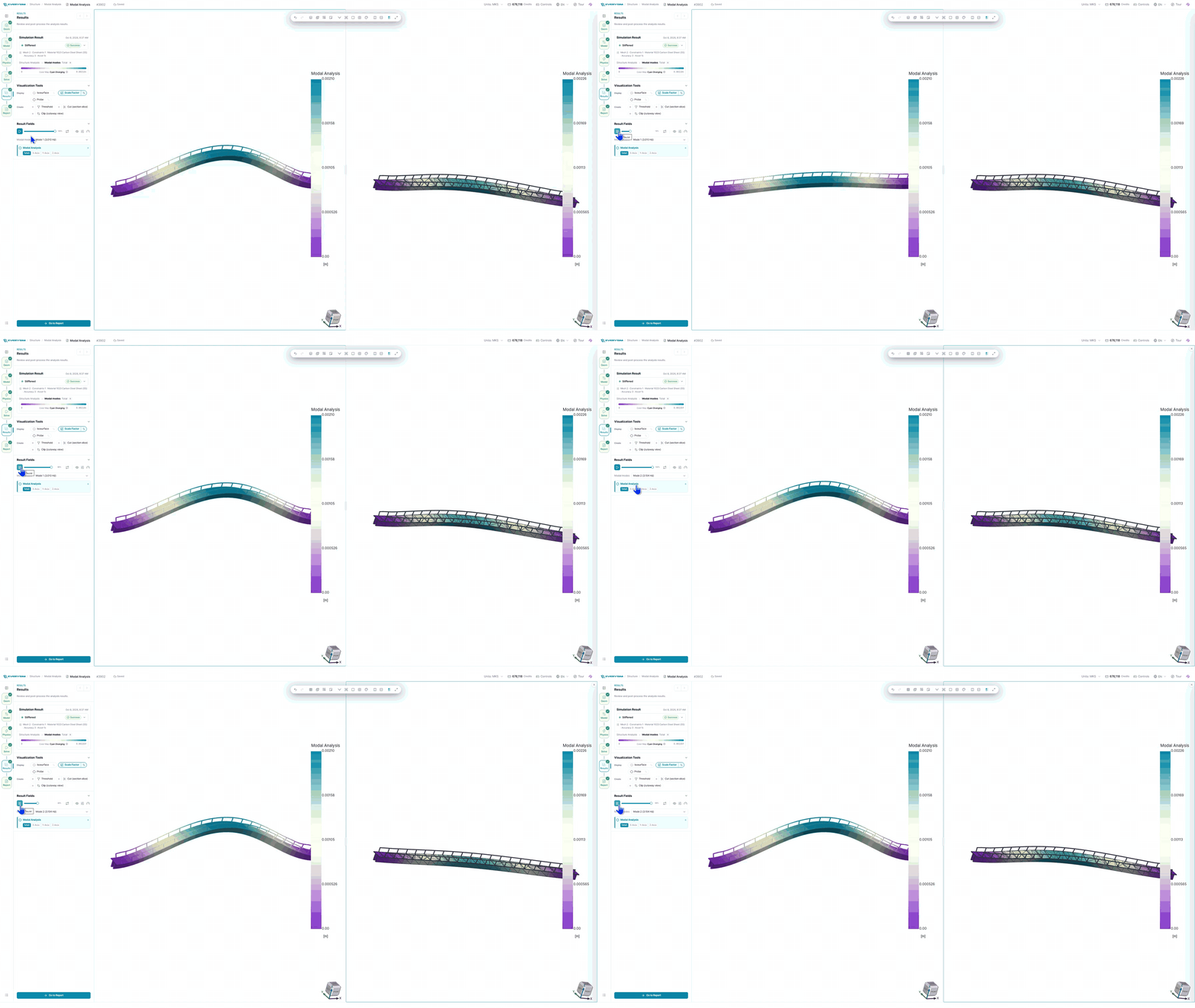
We went for stiffness. We deepened the girders under the deck from 1.15 m to 1.7 m, along with the cross beams between them, which adds far more stiffness than weight. Then we ran the same setup again.
Original deck | Stiffened deck | |
|---|---|---|
Bounce mode frequency | 2.21 Hz | 3.01 Hz |
Against the walking band | Inside | Above |
Sideways mode frequency | 3.23 Hz | 3.10 Hz |
Bounce mode of the original deck at 2.21 Hz next to the stiffened deck at 3.01 Hz: the same shape, at a faster pace.
One design change and two more minutes of computing raised the bounce mode's frequency by 36%, from 2.21 Hz to 3.01 Hz, clear of the walking band. Real bridges can be stiffened in the same way or fitted with dampers, which absorb vibration energy instead of shifting the frequency. That's how the Millennium Bridge's swaying problem was resolved: it reopened in 2002 with dampers fitted and has been steady ever since.
Before we wrap up, there's a limit to what this tells us. Modal analysis shows which rhythms could cause resonance. It doesn't tell us how far the deck would actually move or whether it could withstand that motion. That takes further analysis with a specific load and, for a real bridge, a licensed structural engineer's review. Those next steps begin with this same list of frequencies.
It Is Not Just Bridges
So let's come back to where we started. The weight of 74 men alone doesn't explain Broughton's collapse. Their steps matched the bridge's rhythm. Strength matters when a structure carries a load, but frequency also affects how strongly it responds to a repeated force.
The same principle reaches far beyond bridges. It's one reason an earthquake can wreck one building and spare its neighbor. It's why a drone arm buzzes at one motor speed but not another, and why a shelf rattles only during the washing machine's spin cycle. Every object around you has its own rhythms. Somewhere nearby, something may be moving at just the right pace to set it off.
Curious what your own design is tuned to? If you have a STEP file on your computer, you're only a few minutes away from knowing its natural frequencies and watching its mode shapes move. Open a modal analysis project in EverySim and find out, before something else does.
EverySim Dev Team
Company
The EverySim Dev Team is responsible for sharing insights, updates, and knowledge about Everysim’s vision, technology, and industry trends.
Comment
No comments yet.
Be the first to leave one!
Write a comment


Why Soldiers Break Step on Bridges

