2.3. Motor Spec
Quick Theory
Motor specification calculations compute thrust per motor and estimate ESC current requirements using the following formulas:
Thrust Per Motor Calculation
ESC Current Calculation
| Symbol | Description | Unit |
|---|---|---|
| Thrust Per Motor | N (Newtons) | |
| Thrust-to-Weight Ratio | - (dimensionless) | |
| Total Mass | kg (kilograms) | |
| Gravitational Acceleration | m/s² (approx. 9.81) | |
| Number of Motors | count | |
| ESC Current | A (Amperes) | |
| Average Pack Voltage | V (Volts) | |
| Hover Power | W (Watts) |
The Motor Spec Calculator offers Standard and Advanced options for users to choose from.
Regardless of the option selected, the motor spec calculation results provide the following information:
- Thrust per Motor [gf, with N in brackets]
- ESC Avg Current [A]
- ESC Peak Current [A]: 1.2 x the average current
- ESC Recommendation [A]: The peak current rounded up to the next 5 A
- Hover Power [W]
- Confidence and Design Risk
- Related actions such as Check Flight Time and Check Current Consumption, shown when T/W and current are in the typical range. Below T/W 1.8, the result shows advice such as Increase T/W or Reduce Weight instead, and it does not lead to another calculator.
- Export CSV: Downloads the inputs and results; disabled while an input is invalid
- Save Design: Does not store calculations at this time. The button is disabled when you are signed in, and visitors see a sign-up prompt.
The ESC figures here use a different peak model from the Power & Current calculator, so the same inputs can give different values. Motor Spec takes 1.2 x average with no added margin. Power & Current takes 1.4 x average, then adds a 1.2 x margin for its ESC Recommendation.
2.3.1. Standard
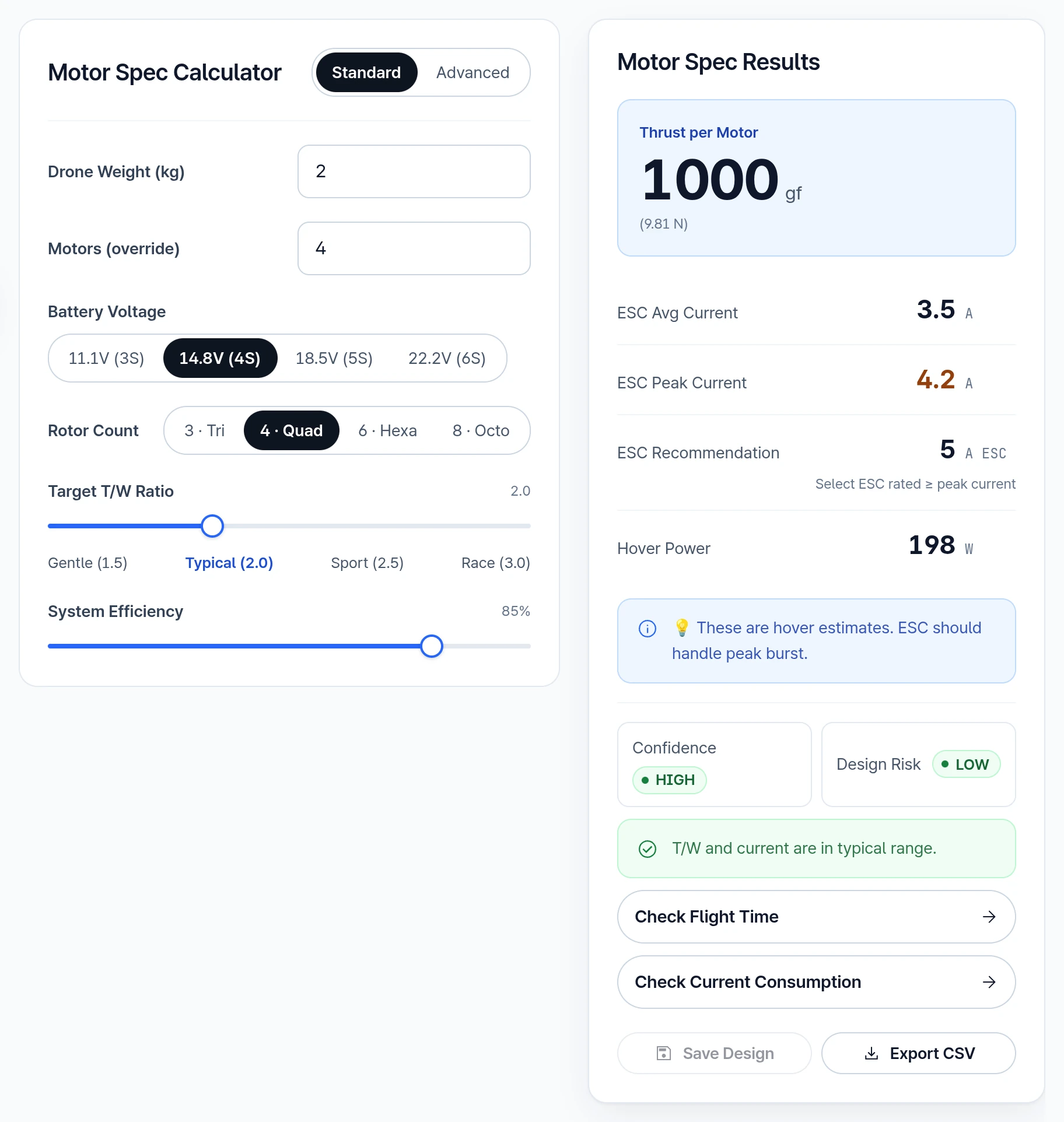
Input Parameters
- Drone Weight (kg)
- Motors (override)
- Battery Voltage: 11.1V (3S), 14.8V (4S), 18.5V (5S) or 22.2V (6S). These labels are nominal Li-Po values; calculations use an average 3.5 V per cell.
- Rotor Count: Sets Motors (override) to 3, 4, 6 or 8
- Target T/W Ratio: Slider from 1.0 to 4.0, with Gentle (1.5), Typical (2.0), Sport (2.5) and Race (3.0) presets
- System Efficiency: Power efficiency
2.3.2. Advanced
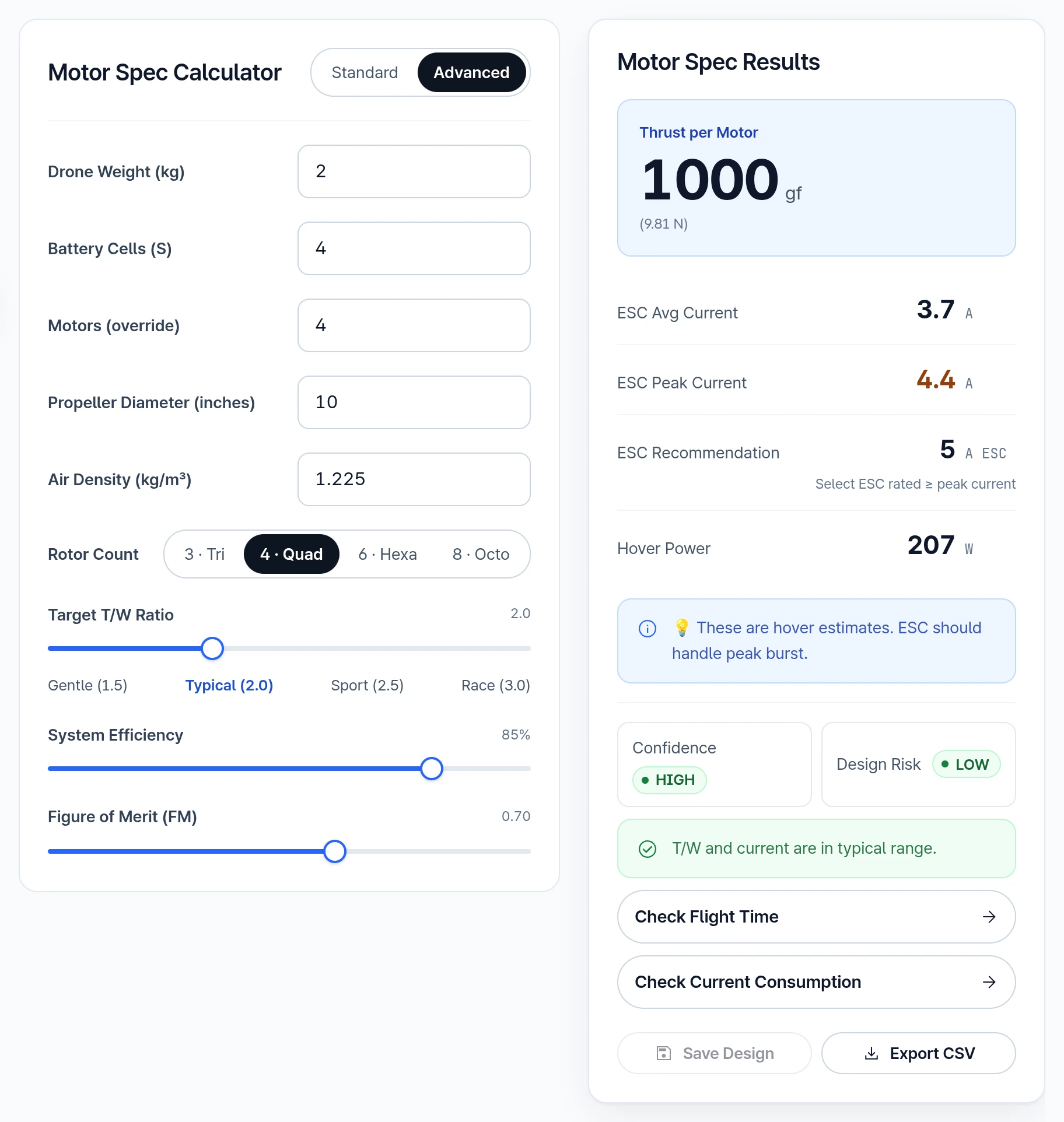
Input Parameters
- Drone Weight (kg)
- Battery Cells (S): Based on Li-Po; calculations use an average 3.5 V per cell (nominal 3.7 V)
- Motors (override)
- Propeller Diameter (inches)
- Air Density (kg/m³)
- Rotor Count: Sets Motors (override) to 3, 4, 6 or 8
- Target T/W Ratio: Slider from 1.0 to 4.0, with the same presets as Standard
- System Efficiency: Power efficiency
- Figure of Merit (FM): Coefficient representing propeller performance efficiency
To learn about propeller performance using CAD, please refer to Advanced Simulation: Fluid Dynamics.
Need Assistance or Have Questions?
Frequently Asked Questions: FAQ Link
Support Inquiries: support@everysim.io